YOUR EPOXY QUESTIONS, ANSWERED
LOUISVILLE'S TOUGHEST
FLOORING ANSWERS
Everything you need to know about cost, durability, and commercial coatings before making an investment.
Direct Technical Support Line : No Sales Runaround : Free Coating Estimates
NAVIGATION HUB
FAQ TOPICS
01. ESSENTIALS & RESIDENTIAL
NEED PROJECT ADVICE?
Speak directly with Louisville floor technicians regarding slab moisture tests, heavy vehicle loads, and garage conditioning.
GARAGE & RESIDENTIAL FUNDAMENTALS
THE ESSENTIALS
Clear engineering answers to the most common structural, chemical, and functional questions regarding high-performance residential epoxy floor coatings.
What exactly is a 100% solids residential epoxy coating?
Unlike consumer-grade roll-on sealers that dry through evaporation, 100% solids epoxy is an industrial thermoset polymer formed by an exothermic reaction between resin and cycloaliphatic polyamine hardeners. When catalyzed, it cross-links directly within concrete capillaries to form an impenetrable, high-compressive-strength solid layer with zero volatile organic compound (VOC) shrinkage.
Is residential epoxy coating just a thicker form of concrete floor paint?
No. Concrete paint is simply water-based or oil-based latex that sticks mechanically to the top of the slab, breaking down rapidly under vehicular stress. Epoxy is an engineered polymer resin system that bonds chemically into open concrete pores, providing a dense monolithic shield up to 30 times thicker that will not peel, flake, or lift under heavy point loads.
How resilient is the finished surface against hot-tire pickup and chemical spills?
Hot-tire pickup occurs when soft vehicle tires cool on inferior acrylic paints, grabbing the coating as rubber shrinks. Because industrial epoxy cures into a thermoset solid with exceptional heat tolerance, it withstands tire temperatures exceeding 140°F without softening. It remains completely impervious to motor oil, gasoline, brake fluids, and de-icing salts.
Can epoxy be successfully installed over cracked, pitted, or uneven concrete?
Yes. Every professional application begins with thorough structural rehabilitation. Pits, spalls, and fractures are chased with diamond blades and filled using rigid high-tensile epoxy or polyurea repair compounds before grinding the slab completely flat. The pigmented epoxy base coat then encapsulates the slab into a seamless, unbroken surface.
What is the typical curing timeline before the garage is ready for vehicle traffic?
Under standard residential conditions (65°F to 75°F), the surface cures for safe pedestrian foot traffic in 24 hours. Light storage items and toolboxes can be returned at 48 hours, while full vehicular parking and heavy mechanical loading are authorized at 72 hours once optimal cross-link density and Shore D hardness are reached.
PRO-TIP: MECHANICAL CONCRETE PREPARATION DETERMINES 90% OF COATING ADHESION
Acid washing or pressure cleaning cannot properly profile concrete. Without mechanical diamond grinding to open pores to an ICRI Concrete Surface Profile (CSP) of 2 to 3, epoxy cannot penetrate deep enough to form a permanent physical anchor. True lifetime performance starts in the concrete matrix.
ENGINEERED POLYMER SCIENCE
EPOXY VS POLYASPARTIC
A direct side-by-side technical evaluation of chemical cross-linking, thermal cycling tolerance, and UV degradation dynamics for industrial and residential flooring.
CORE PERFORMANCE METRICS
While 100% solids epoxy provides superior raw film thickness and mechanical anchorage into porous concrete, pure polyaspartic ester aliphatic chemistry excels in rapid cure kinetics, extreme elongation flexibility, and permanent UV transparency.
- Cure Time & Return to Service: Standard 100% solids epoxy requires 24-72 hours to achieve pedestrian and vehicular cure. Fast-cure polyaspartic fully polymerizes within 4-6 hours, allowing complete next-day vehicular traffic.
- UV Stability & Solar Ambering: Epoxy naturally chalks, discolors, and turns amber under direct sunlight due to aromatic bisphenol chains. Polyaspartic coatings utilize 100% aliphatic polyurea bonds that never yellow or degrade from UV exposure.
- Thermal Flexibility & Hot-Tire Pickup: Epoxy becomes brittle with thermal swings, risking delamination from hot tires. Polyaspartic provides up to 300% more flexural elongation, seamlessly bridging sub-surface thermal contraction.
TOPIC DIRECTORY & OVERVIEW
The Essentials
High-impact answers on chemistry, mechanical adhesion, safety traction, and investment durability before you upgrade your concrete.
01. ESSENTIALS & SPECS
02. PREPARATION & GRINDING
03. COST & VALUE EQUATION
04. TRACTION & SLIP SAFETY
What is epoxy, and how is it fundamentally different from concrete paint?
Unlike single-stage garage floor paint that simply dries as water evaporates, industrial epoxy is a two-component thermoset polymer consisting of resin and a cycloaliphatic polyamine activator. When mixed, a cross-linking chemical reaction fuses the coating deep into the concrete's open pore structure. This yields an impervious, high-build membrane with compressive strength exceeding 10,000 PSI that cannot simply be scrubbed or peeled off.
Is a professional floor coating truly worth the investment over store-bought DIY kits?
Store-bought waterborne kits contain up to 50% water or solvents, leaving behind an ultra-thin 2-3 mil film that routinely delaminates within 18 months under tire heat (hot-tire pickup). Our commercial 100% solids epoxy builds a heavy 15-20 mil barrier that resists automotive fluid spills, impact chipping, and thermal shock. Over a 15-year lifecycle, a professional installation costs dramatically less per square foot by eliminating repetitive stripping and repainting cycles.
Why is mechanical diamond grinding necessary instead of quick acid etching?
Over 90% of coating bond failures stem directly from inadequate surface profiling. Muriatic acid washes only react with weak surface laitance, leave inconsistent acidity pockets, and push moisture deep into the slab. We employ heavy planetary diamond grinders with HEPA dust collection to mechanically open the concrete capillaries to an industry-standard CSP-2 profile, establishing a tenacious mechanical anchor for lifetime adhesion.
Is a high-gloss finish slippery when wet, and is it safe for daily residential use?
While an untextured high-gloss resin can be slick when wet, our installations integrate micronized aluminum oxide and polymer aggregate slip-resistant textures directly into the clear topcoat. This produces a micro-textured grip that easily meets or exceeds OSHA and ADA wet coefficient of friction standards, keeping garage and workshop foot traffic safe even in damp winter conditions.
How durable is the cured finish against hot tires, salt, oil, and dropping tools?
Once fully cured, 100% solids industrial epoxy forms a dense chemical barrier that is completely impervious to motor oil, brake fluid, de-icing brines, and gasoline. Because its tensile and compressive ratings surpass the underlying concrete, dropped hand tools and floor jacks will not crack the bond. It eliminates hot-tire pickup permanently by withstanding localized heat transfer up to 140 degrees Fahrenheit without softening.
PRO-TIP: MECHANICAL PREPARATION MAKES OR BREAKS THE BOND
Never accept chemical acid washing as a prep method. Acid washing fails to profile hard troweled concrete evenly and traps moisture salts under the slab. True lifetime bonding mandates commercial diamond grinding to open concrete pores to an engineered CSP-2 mechanical anchor profile.
ARCHITECTURAL FLOOR COATING FINISHES
Engineered Beauty
LIQUID 3D METALLIC SYSTEM
FULL-BROADCAST FLAKE SYSTEM
LOCAL SERVICE FOOTPRINT
Serving Greater Louisville
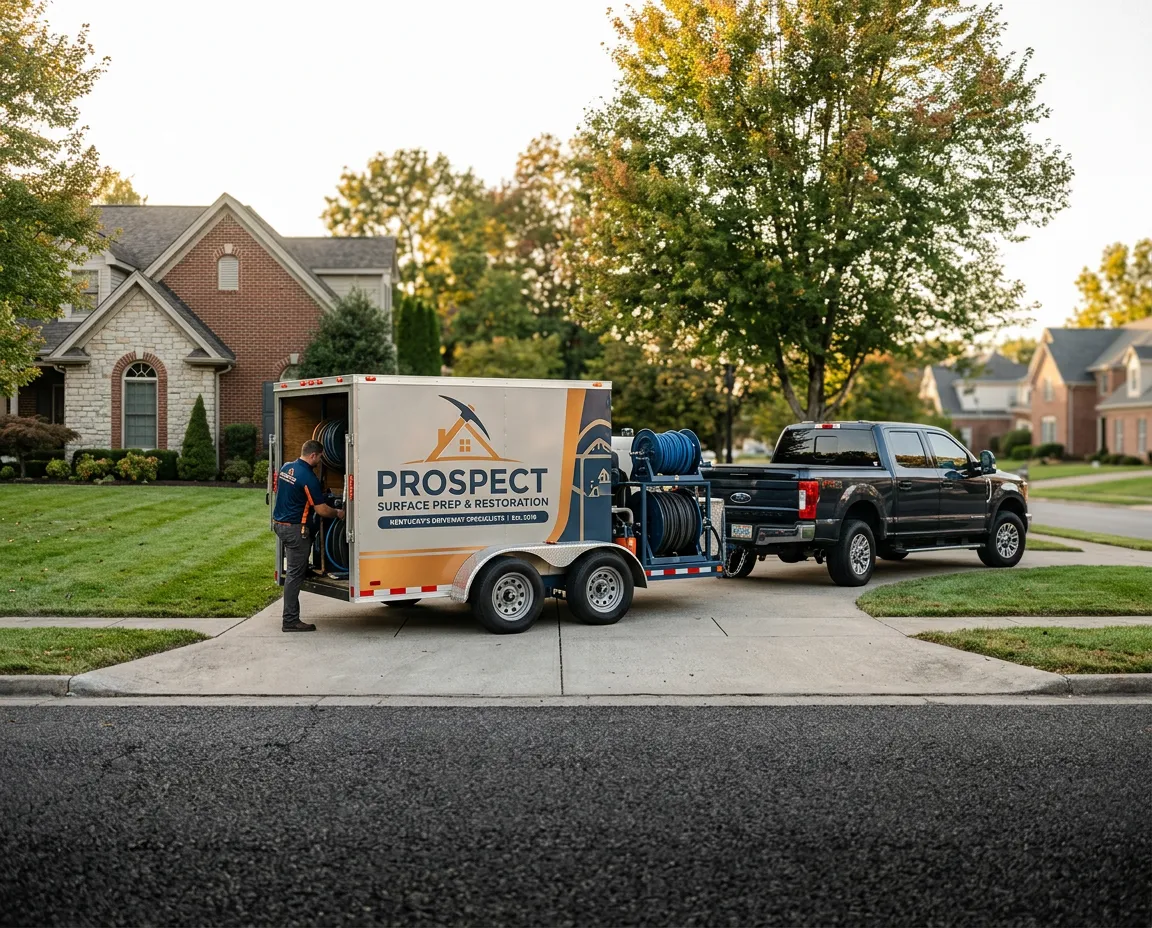
Louisville Floor Coatings operates dedicated, fully outfitted mobile coating rigs across Jefferson County, Oldham County, and surrounding communities. From residential garages along River Road to heavy-traffic commercial bays in Jeffersontown, our certified crews bring industrial-grade diamond grinding and 100% solids polyaspartic technology directly to your site.
- St. Matthews & Indian Hills
- Prospect & Glenview Estates
- The Highlands & Cherokee Triangle
- Jeffersontown & Plainview
- Middletown & Beckley Woods
- Anchorage & Lake Forest
- Hurstbourne & Oxmoor Woods
- Norton Commons & Springhurst
- Crestwood & Oldham County
- Southern Indiana (Clarksville/New Albany)
Direct Dispatch Line: (502) 555-FLOR | Fast local consultations across Jefferson & Oldham County.
LOCAL DISPATCH PROMISE
Every project is surveyed and executed by full-time Louisville technicians. No third-party subcontractors, guaranteed moisture testing, and turnkey one-day installations.
GET STARTED TODAY
READY TO UPGRADE?
Stop guessing and get an expert assessment of your concrete floor. Louisville's trusted industrial-grade coating specialists deliver precision prep, pure polyaspartic topcoats, and lifetime adhesion guarantee.
Free, no-obligation estimates in Louisville • Direct connection to a certified master applicator
PATH 1: DIRECT CALL
Speak immediately with a Louisville concrete flooring specialist. Immediate sizing questions, urgent job site evaluations, and rapid dispatch.
PATH 2: FREE ESTIMATE
Schedule a complimentary on-site moisture and slab density check. Receive an itemized, transparent project quote with zero pressure or hidden charges.
PATH 3: ASK A QUESTION
Unsure whether standard epoxy or polyaspartic is right for your slab? Read our technical FAQ or submit your floor conditions for custom review.
Louisville's authority in industrial-grade polyaspartic and epoxy floor systems. Engineered for extreme chemical resistance, heavy vehicle loads, and rapid turnaround across Kentucky.
Kentucky Contractor ID: #KY-49208-EPX
Commercial & Residential Certified Applicator
SERVICES
Garage Floors
Polyaspartic
Flake Epoxy
Metallic Epoxy
Patio Coatings
Commercial Floors
SERVICE AREAS
Jeffersontown
Middletown
Anchorage
St. Matthews
Prospect
Crestwood
La Grange
Shelbyville
RESOURCES
Flooring Cost
Garage Floor Cost
Epoxy vs Polyaspartic
FAQs
How Long Epoxy Lasts
COMPANY
About
Gallery
Contact
Blogs
(502) 586-4495 Direct Technical Estimator Line
7301 Industry Rd, Louisville, KY 40228
Mon - Sat: 7:00 AM - 6:30 PM


© 2026 Louisville Floor Coatings. All rights reserved. Industrial Polyaspartic & High-Performance Epoxy Systems. Serving Louisville, Jefferson County, and Southern Indiana.