LOUISVILLE FLOOR COATINGS
HOW LONG DOES EPOXY FLOORING LAST?
Floor lifespan is not an accident: it is engineered. Depending on concrete mechanical preparation, moisture barrier integrity, and multi-layer chemical topcoats, durable coatings range from 2-3 years for basic DIY kits to over 20+ years for industrial-grade systems.
Call 502-586-4495 • Direct Technical Advice • Transparent On-Site Pricing
ENVIRONMENT COMPARISON PANEL
LIFESPAN BY ENVIRONMENT
Substrate conditions, moisture migration, and mechanical abrasion dictate surface performance. Review how industrial polymer systems respond across distinct spatial workloads.
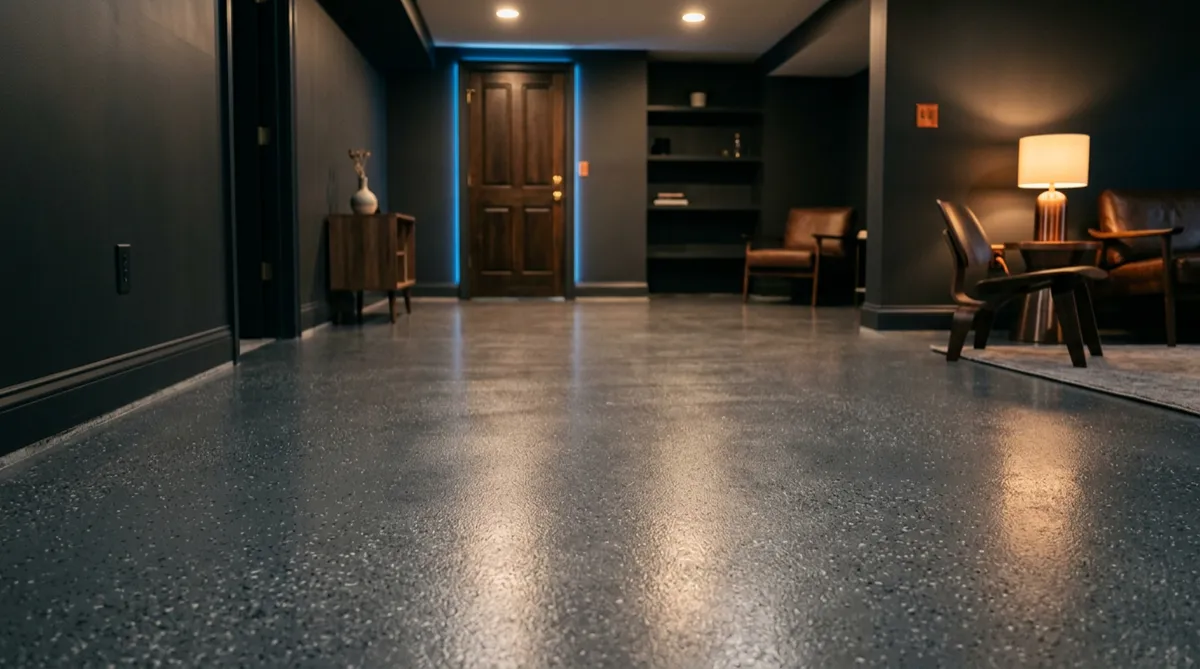
BELOW-GRADE RESIDENTIAL
BASEMENTS
20–25+ YEARS
Protected from ultraviolet rays and vehicular loads, basement installations encounter hydro-static pressure rather than impact wear.
- Hydrostatic moisture vapor transmission
- Mild continuous foot traffic
- Zero UV photodegradation risk
- Complete resistance to seasonal dampness
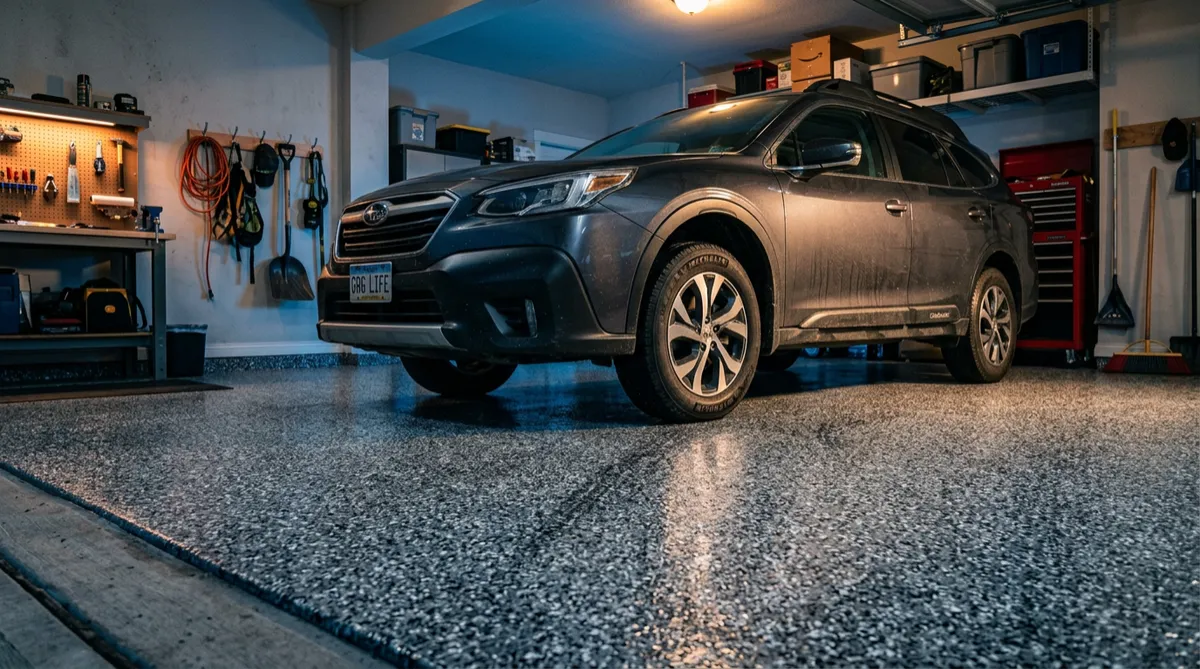
MOST REQUESTED ENVIRONMENT
GARAGES
15–20 YEARS
Confronts plasticizer migration from hot tires, winter de-icing road salts, dropped tools, and periodic direct ultraviolet doorway spillover.
- Hot-tire pickup and thermal shock resistance
- Magnesium chloride and road salt corrosion
- Automotive fluids, battery acids, and motor oil
- Point-impact resistance for jacks and hand tools
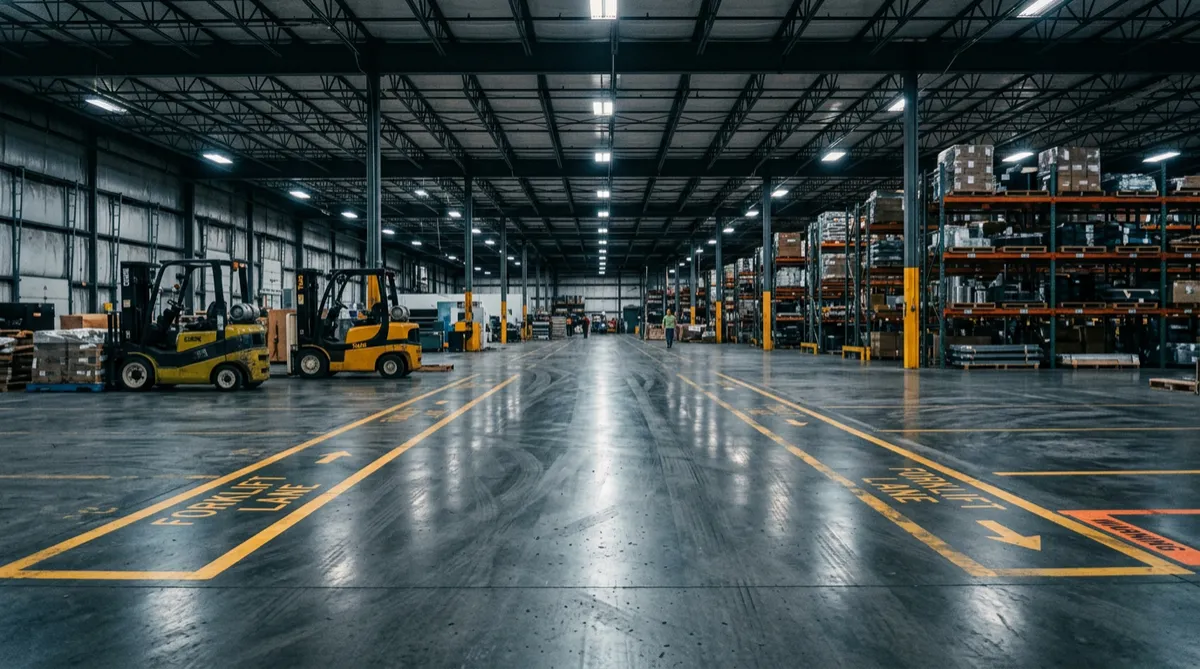
HIGH-INTENSITY INDUSTRIAL
COMMERCIAL
7–12 YEARS
Undergoes relentless mechanical scraping from hard-wheeled forklifts, continuous foot traffic, caustic chemical contact, and daily washdowns.
- Continuous pallet jack and forklift shear forces
- Aggressive industrial degreasers and solvents
- High-volume repetitive foot abrasion zones
- Periodic maintenance topcoat replenishment cycle
ENGINEERED SUBSTRATE INTEGRITY
THE SCIENCE OF PREPARATION
Over 90% of coating delaminations occur not from chemical breakdown, but from deficient surface profiling and trapped moisture. True commercial longevity starts with mechanical adhesion.
PHASE 01: SUBSTRATE PROFILE
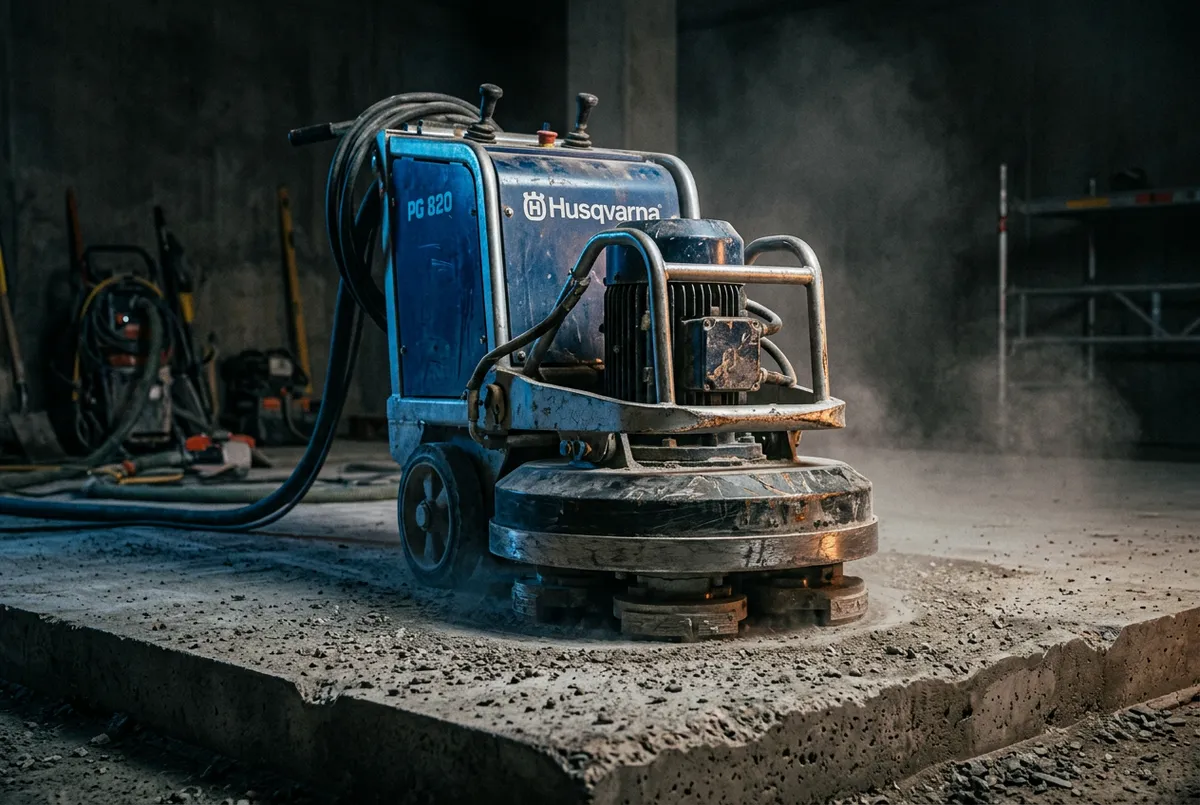
THE FOUNDATION: DIAMOND GRINDING & MOISTURE REMEDIATION
Delamination is almost universally a prep failure, not a resin flaw. Acid etching only washes the surface dust. Commercial planetary diamond grinders aggressively open the concrete pores to a CSP-2 or CSP-3 profile, fracturing the smooth laitance layer so the polymer can form a mechanical root structure within the slab.
- Planetary diamond-grind mechanical profiling (CSP-2 to CSP-3 specification)
- Deep crack and spall reconstruction using low-viscosity structural polyurea
- Moisture vapor barrier mitigation resisting hydrostatic pressure up to 15 lbs / 1,000 sq ft
PHASE 02: MULTI-TIER LAMINATION
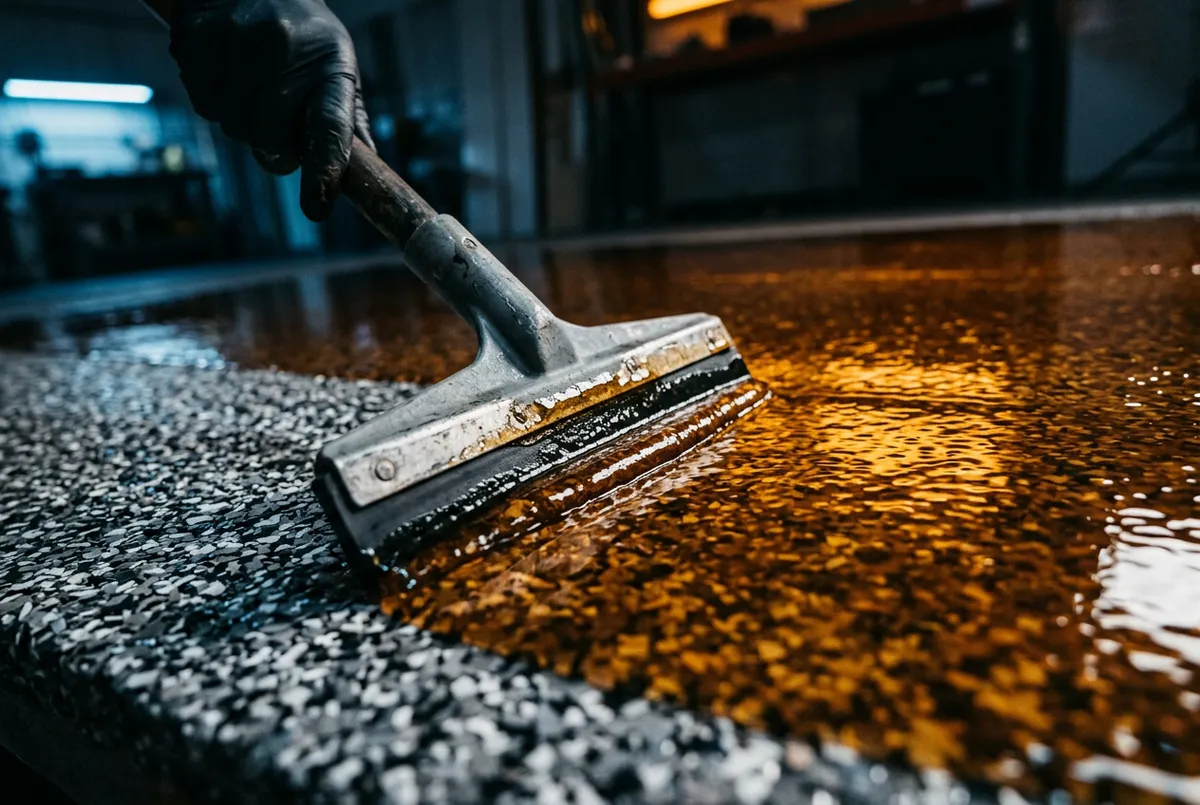
THE LAYERS: BASE COAT ANCHOR VS HARDENED TOPCOAT SHIELD
Single-coat big-box kits attempt to anchor and defend simultaneously, failing at both. Professional multi-layer systems use a dedicated 100% solids epoxy base coat engineered strictly for elongation and tensile bond strength, followed by a broadcast flake matrix, and locked with an aliphatic polyaspartic topcoat that resists hot tire pickup, hydraulic fluids, and yellowing UV exposure.
- High-penetration 100% solids base coat achieving >450 PSI concrete pull-off adhesion
- Full-saturation broadcast flake barrier delivering impact resilience and slip resistance
- Dual-component polyaspartic clear topcoat with 4x the abrasion resistance of standard epoxy
RESIN ARCHITECTURE & CHEMISTRY
COMPARING SYSTEM DURABILITY
A floor coating's real-world lifespan is fundamentally governed by resin density and cross-linking elasticity. The base coat establishes an irreversible mechanical tooth into prepared concrete, while the topcoat absorbs tire friction, hot chemicals, and UV exposure. Professional installations combine high-adhesion 100% solids epoxy primers with polyaspartic clear shields to yield up to 20+ years of operational durability.
Industrial standard: 100% solids epoxy base with dual polyaspartic coats.
EXPECTED LIFESPAN: 15-20+ YEARS
FULL BROADCAST FLAKE SYSTEM
- UV RESISTANCE: High with polyaspartic armor coat; prevents yellowing under skylights and open garage doors
- ABRASION TOLERANCE: Industrial grade; vinyl chips disperse point impacts and resist hot-tire pickup
- IDEAL APPLICATION: High-traffic residential garages, active workshops, and commercial storage bays
EXPECTED LIFESPAN: 12-15 YEARS
DESIGNER METALLIC RESIN
- UV RESISTANCE: Moderate; optimized for climate-controlled indoor settings and non-direct sunlight
- ABRASION TOLERANCE: High chemical resistance; requires protective urethane clear coat against micro-scratches
- IDEAL APPLICATION: Finished luxury basements, executive retail spaces, entertainment rooms, and showrooms
EXPECTED LIFESPAN: 20+ YEARS (MAXIMUM RESILIENCE)
ALL-POLYASPARTIC HYBRID BUILD
- UV RESISTANCE: 100% Aliphatic polymer backbone; zero chalking or discoloration even in direct outdoor sun
- ABRASION TOLERANCE: 4x greater elongation flexibility than standard epoxy; zero cracking under freeze-thaw cycles
- IDEAL APPLICATION: Exterior patios, sunrooms, commercial loading docks, and rapid 1-day return-to-service projects
LIFESPAN PRESERVATION PROTOCOL
EXTEND YOUR FLOOR'S LIFE
Engineered multi-layer coatings are built for decades of industrial resistance. Follow these four maintenance protocols to eliminate premature wear and maximize coating clarity.
PROTOCOL 01
SWEEP REGULARLY
Remove grit, sand, and abrasive particles weekly with a soft microfiber broom to eliminate microscopic finish abrasion from vehicle foot traffic.
PROTOCOL 02
CLEAN SPILLS PROMPTLY
Wipe motor oil, brake fluid, battery acid, and chemical residues immediately. Even impervious polyaspartic coats perform best when fluid dwell time is minimized.
PROTOCOL 03
AVOID HARSH CHEMICALS
Skip citrus degreasers, bleach solutions, and abrasive scour pads. Maintain pristine optical clarity using pure warm water mixed with a standard pH-neutral cleaner.
PROTOCOL 04
USE LOAD PROTECTION
Deploy rubber pads or wood blocks beneath heavy steel jack stands, motorcycle kickstands, and pinpoint welding equipment to distribute concentrated point loads.
TECHNICAL ASSESSMENT & FIELD DATA
EXPERT ANSWERS
Louisville Floor Coatings builds high-integrity industrial and residential surfaces engineered for multi-decade durability. Review technical answers to critical chemical, UV, and substrate questions below.
DOES EPOXY WEAR OUT OVER TIME?
Professional industrial-grade epoxy systems do not wear down through normal foot traffic or vehicle use. Wear occurs strictly when abrasive debris is ground into sacrificial coatings or when thin DIY paint kits lack solid body thickness. Our 100% solids epoxy base with an aliphatic polyaspartic clear shield creates an impermeable matrix engineered for 15 to 20+ years of continuous service life.
WILL DIRECT SUNLIGHT OR UV EXPOSURE CAUSE YELLOWING AND CHIPPING?
Standard aromatic epoxies can amber when exposed to prolonged sunlight. To eliminate this issue permanently, Louisville Floor Coatings applies an aliphatic polyaspartic topcoat. This UV-stable chemistry deflects solar radiation without chalking, fading, or losing optical clarity along garage aprons and exterior doorways.
CAN EXISTING EPOXY FLOORS BE RECOATED OR REFRESHED?
Yes. If an intact existing coating requires color updating or gloss restoration, we perform a mechanical diamond screening to profile the surface, clean the residue, and apply a fresh cross-linking polyaspartic or urethane topcoat. If an old system suffers from delamination or improper prep, full mechanical removal down to bare concrete is required for structural bonding.
WHAT PREVENTS THE COATING FROM CRACKING IF THE CONCRETE SHIFTS?
Before coating installation, our technicians route and fill all static slab fissures using elastomeric polyurea crack weld compounds. While no topical floor can prevent radical structural seismic movement, our flexible base coat tolerates micro-vibrations and seasonal thermal expansion far better than brittle water-based paints.
WHAT CAUSES 'HOT TIRE PICKUP' AND HOW DO YOU PREVENT IT?
Hot tire pickup occurs when vehicle tires heated from highway driving park on inferior paint. The cooling tire tread contracts, creating plasticizer migration that pulls the paint clean off the slab. Our systems chemically cross-link with CSP-3 mechanically profiled concrete, resisting temperatures up to 300°F with zero plasticizer adhesion.
HOW DOES SUB-SLAB MOISTURE IMPACT EPOXY LONGEVITY?
Unmitigated hydrostatic moisture pressure rising from the earth is the primary reason DIY coatings bubble and peel. We measure slab relative humidity before installation and apply an industrial-grade epoxy moisture mitigation primer capable of withstanding moisture vapor emission rates up to 12 lbs per 1,000 sq ft.
FINAL STEP : LOUISVILLE FLOOR COATING ESTIMATES
READY FOR A FLOOR THAT LASTS?
The life of your floor starts before the coating is applied. Trust our professional prep and premium polyaspartic topcoats.
Accurate on-site laser diagnostics : Fixed price quote : No obligation
DIRECT ESTIMATE HOTLINE
CALL 502-586-4495
Speak directly with a Louisville concrete coating specialist. Instant scheduling for residential and commercial floor inspections.
Louisville's authority in industrial-grade polyaspartic and epoxy floor systems. Engineered for extreme chemical resistance, heavy vehicle loads, and rapid turnaround across Kentucky.
Kentucky Contractor ID: #KY-49208-EPX
Commercial & Residential Certified Applicator
SERVICES
Garage Floors
Polyaspartic
Flake Epoxy
Metallic Epoxy
Patio Coatings
Commercial Floors
SERVICE AREAS
Jeffersontown
Middletown
Anchorage
St. Matthews
Prospect
Crestwood
La Grange
Shelbyville
RESOURCES
Flooring Cost
Garage Floor Cost
Epoxy vs Polyaspartic
FAQs
How Long Epoxy Lasts
COMPANY
About
Gallery
Contact
Blogs
(502) 586-4495 Direct Technical Estimator Line
7301 Industry Rd, Louisville, KY 40228
Mon - Sat: 7:00 AM - 6:30 PM


© 2026 Louisville Floor Coatings. All rights reserved. Industrial Polyaspartic & High-Performance Epoxy Systems. Serving Louisville, Jefferson County, and Southern Indiana.