LOUISVILLE FLOOR COATINGS
EPOXY VS. POLYASPARTIC
FLOORING
Selecting the right coating system determines whether your concrete withstands Louisville's intense freeze-thaw cycles or blisters under hot tires. Compare chemical resistance, return-to-service timelines, and lifecycle costs before you pour.
Direct Consultation: 502-586-4495·Local Louisville Engineering Team
ENGINEERING SPECIFICATION BENCHMARK
AT A GLANCE COMPARISON
High-density comparative metrics for technical decision-making: direct side-by-side parameters evaluating chemical kinetics, thermal threshold, and operational turnaround for Louisville installations.
| Performance Parameter | 100% Solids Industrial Epoxy | Aliphatic Polyaspartic System |
|---|---|---|
| Cure Speed Turnaround to full vehicle load |
24 - 72 Hours
24h Light Walk / 72h Full Vehicle
Extended cross-linking phase. Prolongs project downtime for active residential or commercial facilities.
|
4 - 8 Hours
4h Foot Traffic / 24h Drive-On
Ultra-fast polyurea chemical reaction. Same-day return to service eliminates multi-day staging costs.
|
| Working Time Open pot life during spread |
35 - 50 Minutes
Forgiving Work Window
Slow exotherm reaction affords generous mechanical rolling time and seamless hand-troweled edge blending.
|
15 - 20 Minutes
Compressed Application Margin
Aggressive viscosity spike. Demands a synchronized certified crew with calibrated roller distribution.
|
| UV Stability Color retention under solar exposure |
Aromatic Polymer
Susceptible to Photo-Ambering
Aromatic amine backbones yellow and chalk under UV direct rays unless shielded by a high-grade clear urethane topcoat.
|
100% Aliphatic
Optical Zero-Yellowing Guarantee
Aliphatic molecular chain resists UV radiation breakdown indefinitely, preserving decorative broadcast flake clarity.
|
| Interior vs Exterior Thermal tolerance & environmental rating |
Interior Only
Conditioned Slab Environments
Ideal for climate-controlled basements, enclosed shop floors, and warehouse staging zones protected from freeze-thaw cycles.
|
All-Weather Universal
Interior, Exterior, and Driveways
Withstands Louisville freeze-thaw extremes (-20F to 140F surface range) on patios, porches, garages, and pool aprons.
|
| Capital Investment Installed cost profile per square foot |
$5.50 - $7.50 / sq ft
Economical Baseline Investment
Lower resin commodity pricing delivers high square-footage coverage where rapid turnaround is non-critical.
|
$7.50 - $10.50 / sq ft
Premium Commercial Grade
Higher material synthesis cost offset by 4x abrasion resistance, 1-day completion, and long-term lifespan.
|
Factual comparison compiled by Louisville Floor Coatings field inspectors. Commercial specification consultation available at 502-586-4495.
COATING CHEMISTRY & PROPERTIES
THE MATERIALS EXPLAINED
High-performance floor installations are built on precise chemical foundations. Explore the distinct structural profiles, build thicknesses, and mechanical characteristics that separate traditional 100% solids epoxy from advanced polyaspartic technology.
POLYMER ARCHITECTURE 01
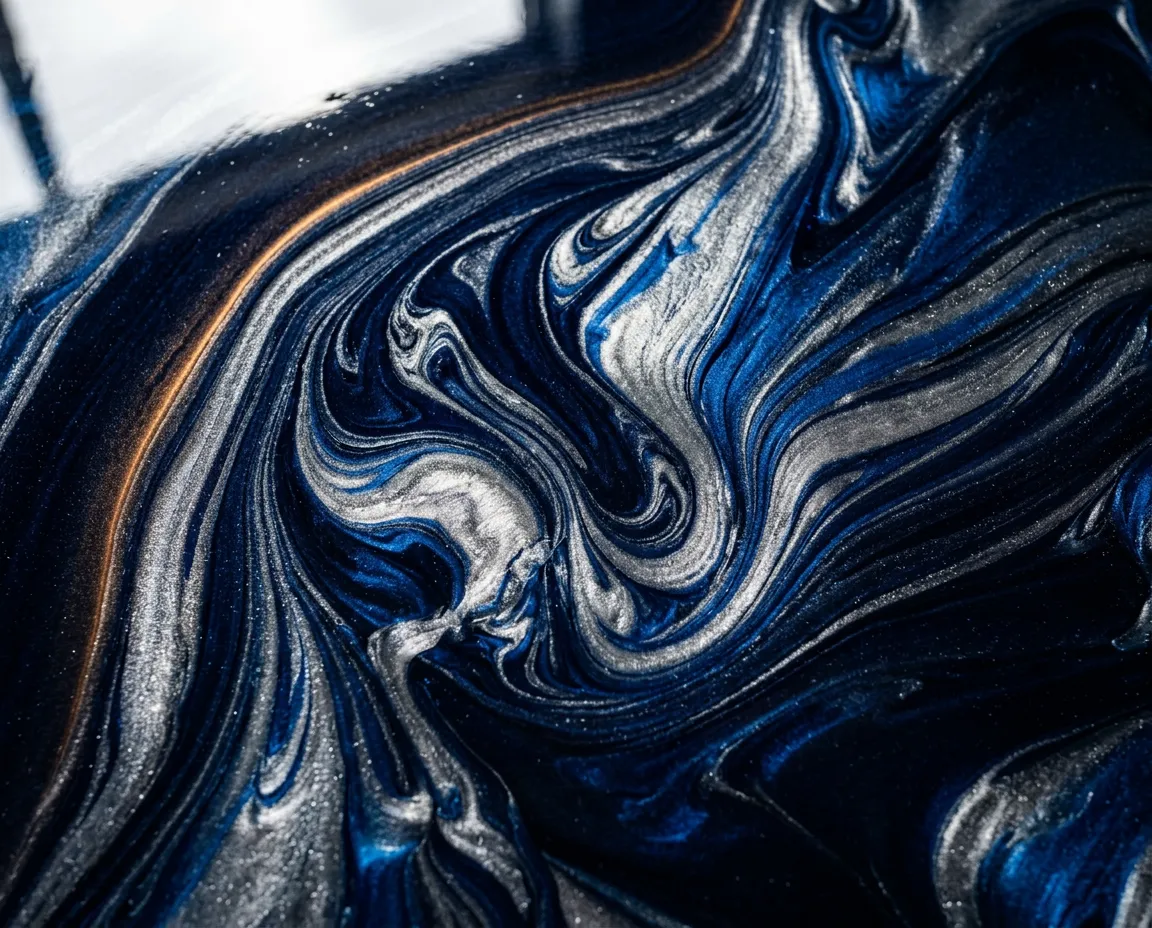
EPOXY FLOORING
What It Is: Epoxy is a thermosetting copolymer system formed by cross-linking epoxide resin with a polyamine curing agent. When blended, the resulting chemical reaction generates tightly packed polymer chains that deliver exceptional adhesion and structural density across profiled concrete.
- High-Build Dry Film Thickness: Delivers 10 to 30 mils per pass to level surface irregularities and pitted concrete slabs
- Superior Substrate Wet-Out: Penetrates deep into open concrete capillary pores (CSP 2-3 profile) for an unbreakable mechanical anchor
- Self-Leveling Viscosity: Floats evenly across broad areas to eliminate floor divots and create an ultra-smooth uniform plane
- Heavy-Duty Base Layer Strength: Serves as the high-mass structural body required for thick decorative metallic and industrial broadcast builds
POLYMER ARCHITECTURE 02
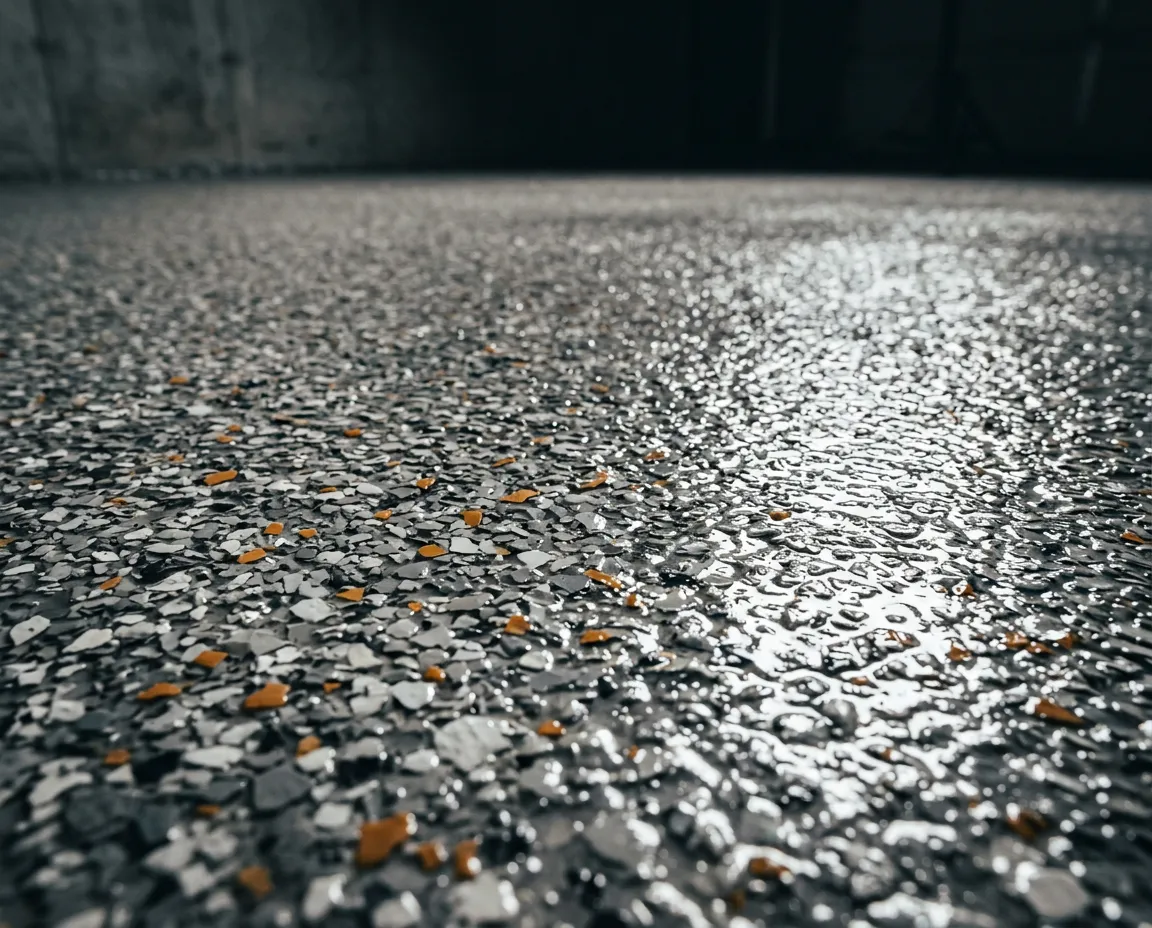
POLYASPARTIC FLOORING
What It Is: Polyaspartic is an advanced aliphatic polyurea ester. Engineered originally to coat steel bridges and marine structures in harsh climates, its modified amine structure allows rapid curing without releasing volatile organic compounds (VOCs) or trapping pinhole moisture.
- 100% Aliphatic UV Resistance: Chemically immune to solar degradation, eliminating ambering, yellowing, or surface chalking over decades
- Rapid Cross-Linking Return-to-Service: Foot traffic ready in 4 to 6 hours and full vehicular parking within 24 hours of application
- Superior Thermal Elongation: Delivers 300% to 400% higher flexural elasticity than epoxy, bridging freeze-thaw expansion cycles
- Industrial Taber Abrasion Toughness: Provides 3x the surface hardness and scratch resistance of conventional industrial epoxies
Engineering Synthesis: In premier commercial and residential floor installations, these two chemistries are frequently paired: thick-build epoxy provides the penetrating foundational body, while thin-film polyaspartic provides the impenetrable, non-yellowing protective topcoat shield.
ENGINEERING & RESIN SPECIFICATIONS
CRITICAL PERFORMANCE FACTORS
Comparative scientific metrics across polymerization kinetics, solar resistance, and substrate bonding profiles.
CURE TIME VISUALIZER
Comparative return-to-service intervals: standard cycloaliphatic epoxy vs. rapid-cure aliphatic polyaspartic.
FACTOR 02 // PHOTO-OXIDATION
UV STABILITY & SOLAR RESISTANCE
Standard aromatic epoxies inherently degrade when exposed to ultraviolet spectrum radiation, causing yellowing, chalking, and micro-fissures within 12–24 months. Polyaspartic chemistries utilize an aliphatic ester polymer chain immune to photo-oxidation, preserving optical clarity permanently in sunlight-exposed garage aprons and commercial bays.
- Epoxy: Susceptible to UV ambering; requires pigmented polyurethane topcoats
- Polyaspartic: 100% Aliphatic formulation guarantees zero yellowing or chalking
FACTOR 03 // SUBSTRATE ADHESION
SURFACE PREP: CSP 2-3 PROFILING
Regardless of resin selection, coating longevity is dictated by substrate preparation. Acid etching fails over 80% of residential floors due to latent calcium salts. Industrial diamond grinding opens the concrete capillaries to a mandatory Concrete Surface Profile (CSP) 2–3, creating a mechanical root anchor.
- Diamond grinding: Non-negotiable baseline for both epoxy and polyaspartic bond strength
- Moisture testing (ASTM F2170): Verifies slab relative humidity is within technical thresholds
SPECIFICATION SELECTOR
SYSTEMS BY ENVIRONMENT
Engineered floor coatings are formulated for specific mechanical and environmental stressors. Select your operational space to review optimal resin build-ups, moisture tolerances, and downtime limits.
GARAGE FLOORS
Vehicular residential bays demand rapid return-to-service and multi-layer aggregate protection. Polyaspartic flake systems cure in 24 hours while defending against hot-tire pickup, road salt pitting, and automotive fluid spills.
- Full-broadcast vinyl flake build
- Drive-on service ready in 24 hours
- 100% UV-stable non-yellowing topcoat
BASEMENTS
Below-grade concrete slabs carry hydrostatic vapor transmission risks. Precision moisture meter evaluation pairs with a deeply penetrating 100% solids epoxy moisture-mitigating primer to eliminate delamination hazards.
- Calcium chloride moisture testing protocol
- High-build epoxy vapor mitigation primer
- Zero-VOC formulation for interior air quality
COMMERCIAL
Warehouses, mechanical bays, and retail spaces require high-compressive resistance and chemical durability. Hybrid high-build systems resist continuous forklift traffic, aggressive solvent wash-downs, and impact gouging.
- Forklift & heavy pallet jack load rated
- Abrasive chemical & solvent wash resistance
- Customized slip-resistant silica traction
TECHNICAL SPECIFICATIONS & CLARITY
EXPERT ANSWERS
There is no single universal coating. The engineered choice depends entirely on your slab moisture profile, ultraviolet exposure, and return-to-service demands. Review direct contractor answers to common industrial and residential objections below.
Is polyaspartic objectively better than epoxy?
Polyaspartic offers superior UV stability, up to 4x higher scratch resistance, and returns to vehicular traffic in 24 hours. However, standard epoxy provides deeper mechanical penetration and superior initial adhesion on porous or moisture-prone concrete slabs. High-performance projects frequently utilize an epoxy base coat paired with a polyaspartic topcoat.
Which coating system lasts longer under daily vehicle use?
A professionally installed polyaspartic topcoat system typically lasts 15 to 20+ years without peeling or yellowing. Standard 100% solids epoxy lasts 10 to 15 years before abrasion dulls the gloss. In garage bays with direct sun or hot tires, polyaspartic retains optical clarity and chemical resistance significantly longer.
Will an epoxy or polyaspartic floor turn yellow over time?
Epoxy resins naturally degrade and amber when exposed to direct or ambient sunlight through open bay doors because they lack aliphatic UV blockers. Polyaspartic chemistry is inherently 100% aliphatic and UV-stable: it will never yellow, chalk, or cloud regardless of solar exposure.
Are polyaspartic and epoxy floors dangerously slippery when wet?
Smooth gloss resin surfaces can be slick when wet. To eliminate this hazard, contractors broadcast full-flake vinyl blends or incorporate aluminum oxide aggregate into the topcoat. This produces a textured, OSHA-compliant slip coefficient suitable for wet automotive bays and winter salt runoff.
What is the true cost difference between the two systems?
Polyaspartic raw material costs run approximately 20% to 35% higher than standard 100% solids epoxy. However, because polyaspartic cures in hours rather than days, installation labor and downtime costs are substantially reduced, narrowing the final installed price gap.
What is hot tire pickup and does polyaspartic prevent it?
Hot tire pickup occurs when heated vehicle tires soften lower-grade coatings, causing the film to de-bond and peel as tires cool and contract. Polyaspartic systems feature extreme thermal tolerance and elongation, preventing hot tire delamination entirely when applied over properly diamond-ground concrete.
What maintenance is required to preserve warranty coverage?
Neither system requires waxing or buffing. Routine maintenance consists of dry dust-mopping and periodic damp washing with a neutral pH cleaner. Harsh acids, bleach, or scouring pads should be avoided. Spilled motor oil, brake fluid, or road salts should be wiped up within 24 hours.
PRECISION DIAGNOSTIC OVER PRODUCT HYPE
START WITH THE CONCRETE
No coating system outperforms the preparation of the slab beneath it. Louisville Floor Coatings starts every project with calibrated moisture testing, hardness profiling, and mechanical surface prep: matching pure polyaspartic or commercial epoxy directly to your concrete's exact technical profile.
ON-SITE SLAB EVALUATION • RH MOISTURE PROBE TESTING • ZERO HIGH-PRESSURE SALES
Louisville's authority in industrial-grade polyaspartic and epoxy floor systems. Engineered for extreme chemical resistance, heavy vehicle loads, and rapid turnaround across Kentucky.
Kentucky Contractor ID: #KY-49208-EPX
Commercial & Residential Certified Applicator
SERVICES
Garage Floors
Polyaspartic
Flake Epoxy
Metallic Epoxy
Patio Coatings
Commercial Floors
SERVICE AREAS
Jeffersontown
Middletown
Anchorage
St. Matthews
Prospect
Crestwood
La Grange
Shelbyville
RESOURCES
Flooring Cost
Garage Floor Cost
Epoxy vs Polyaspartic
FAQs
How Long Epoxy Lasts
COMPANY
About
Gallery
Contact
Blogs
(502) 586-4495 Direct Technical Estimator Line
7301 Industry Rd, Louisville, KY 40228
Mon - Sat: 7:00 AM - 6:30 PM


© 2026 Louisville Floor Coatings. All rights reserved. Industrial Polyaspartic & High-Performance Epoxy Systems. Serving Louisville, Jefferson County, and Southern Indiana.